
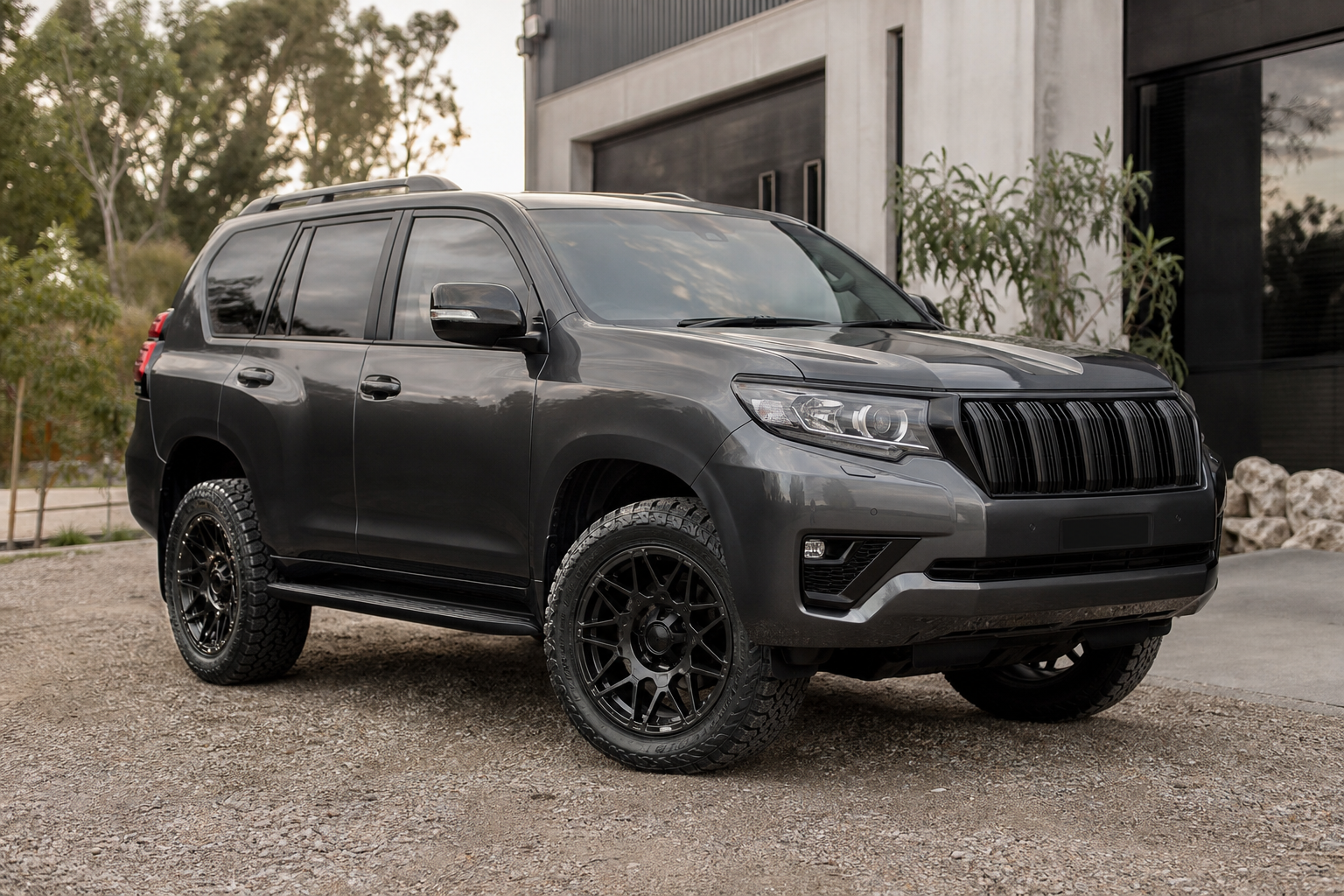
Best Aftermarket Wheels for Toyota Prado 150 Series: Fitment Guide
title: “Best Aftermarket Wheels for Toyota Prado 150 Series: Fitment Guide”
slug: “best-aftermarket-wheels-for-toyota-prado-150-series-fitment-guide”
meta_description: “Toyota Prado 150 Series wheel fitment guide covering bolt pattern, centre bore, offsets, ideal wheel sizes, tyre pairing, load considerations, lift effects, and common mistakes for balanced aftermarket fitment.”
tags:
– Toyota Prado 150 Series
– Prado 150 wheel fitment
– 6×139.7
– 4×4 wheels
– SUV wheels
– offset
category: “Fitment Guides”
—
TL;DR: For most Toyota Prado 150 Series builds, the best all-round aftermarket fitment sits around 17×8 to 18×8.5 with a moderate positive offset, usually somewhere from around +15 to +30 depending on tyre size, suspension height, brake clearance and how the vehicle is actually used. The Prado 150 commonly uses a 6×139.7 PCD, 106.1 mm centre bore and M12x1.5 thread. Factory wheels generally range from 17 to 19 inches depending on trim, but the smartest upgrades usually prioritise load rating, tyre sidewall, steering clearance and real-world suspension travel rather than chasing the biggest diameter that will bolt on.

In This Guide
- About the Toyota Prado 150 Series Platform
- Toyota Prado 150 Series Fitment Specs
- Best Wheel Sizes
- Offset and Width Strategy
- Lift, Load and Suspension Travel Considerations
- Tyre Pairing Guide
- Choosing Wheel Construction
- Common Fitment Mistakes
- Legal Compliance
- FAQ
- References
About the Toyota Prado 150 Series Platform
The Toyota Prado 150 Series is one of those vehicles that makes people overconfident about wheel fitment. It is a body-on-frame four-wheel drive with generous arch space, tall ride height and a reputation for toughness, so many owners assume that if a wheel clears the brakes and matches the stud pattern, it is probably fine. In practice, the Prado is a vehicle where fitment discipline matters a lot. The platform is heavy, often used under load, and frequently fitted with larger all-terrain tyres, recovery gear, roof loads or suspension changes. That means every choice you make in wheel diameter, width and offset has consequences that show up well beyond the driveway photo.
This is why the Prado needs a different mindset from a road-focused crossover or passenger car. On a lower road SUV, the biggest concern might be preserving comfort and avoiding visual imbalance. On a Prado, you also need to think about steering sweep, liner clearance, suspension compression, scrub radius, tyre weight and the way the vehicle behaves on rough surfaces. A setup that feels acceptable on smooth city roads can become vague, heavy or rub-prone once the front suspension articulates or the steering loads up on uneven ground.
The Prado 150 also spans a long production run with multiple trims, wheel sizes and brake package variations depending on market and model year. Some versions came on practical 17-inch packages. Others moved to 18-inch or even 19-inch factory wheels aimed more at premium road use. The shared platform basics create a strong common fitment theme, but the exact wheel that works best still depends on whether the vehicle is closer to a touring build, a daily family 4×4, or a more road-focused spec that rarely leaves sealed roads.
Another point many owners miss is that the Prado often magnifies poor wheel decisions because of its mass. Add a heavy wheel and tyre package at each corner and you are asking a tall, heavy vehicle to manage more unsprung and rotational mass every time it brakes, turns or crashes into a sharp edge. The result can be slower steering response, more suspension harshness and a vehicle that feels more cumbersome than it should. That is why a sensible wheel package on a Prado is not just about clearing the guards. It is about preserving the vehicle’s ability to do its real job well.
If you want a useful refresher on the core dimensions before getting into sizes, start with Wheel Offset, PCD and Centre Bore Explained. If you also want a broader framework for choosing the right wheel for how the vehicle is used, this aftermarket wheel buying guide is worth reading first.
Toyota Prado 150 Series Fitment Specs
The Toyota Prado 150 Series has enough consistency across the range that there is a clear baseline for wheel fitment, although exact factory wheel and tyre packages still vary by trim and year. As always, any vehicle that has been previously modified should be measured rather than assumed to be standard.
- Platform: Toyota Land Cruiser Prado 150 Series
- Years: 2009 onwards in most markets, with facelifts and trim changes through the production run
- PCD: 6×139.7
- Centre Bore: 106.1 mm
- Stud Thread: M12x1.5
- Common Factory Wheel Sizes: 17×7.5, 18×7.5 and on some premium variants 19-inch packages
- Typical Factory Offset: Commonly around +25, with some variation by wheel design and trim
- Common Factory Tyre Sizes: Often 265/65R17, 265/60R18 or similar equivalents depending on specification
- Vehicle Type Note: The Prado is a heavy ladder-frame 4×4, so wheel load rating and tyre construction matter much more than they do on many passenger SUVs
The important numbers to remember are straightforward: 6×139.7 PCD, 106.1 mm centre bore, M12x1.5 hardware, and a factory offset commonly around +25. Those numbers give you the foundation. After that, the real challenge is choosing a wheel and tyre package that suits the Prado’s weight, steering geometry, intended load and suspension travel.
It is also worth noting that factory fitment on the Prado is usually conservative for good reason. Toyota left room for full lock, full compression, chain clearance in some cases, long-distance durability and predictable steering behaviour on a heavy vehicle that may be carrying passengers and cargo. That does not mean the factory specification is the only sensible answer, but it does mean aftermarket fitment should move carefully rather than treating stock settings as a problem that needs to be corrected dramatically.
Best Wheel Sizes
17-inch setups
For many Prado 150 owners, 17 inches is the best overall wheel diameter. It preserves valuable tyre sidewall, keeps the wheel better protected on rough surfaces, and usually gives the broadest tyre choice if the vehicle is used for touring, towing, mixed-surface driving or long-distance travel. On a platform like this, sidewall is not old-fashioned. It is functional. It helps with impact absorption, ride quality and rim protection in situations where the vehicle is asked to do more than simply commute.
A very common and well-balanced size here is 17×8. That width works well with the Prado’s typical tyre sizes, looks fuller than a narrow factory wheel and still leaves room to keep the tyre appropriately proportioned. It is usually the sweet spot for owners who want a stronger stance without making the vehicle feel clumsy or forcing aggressive offset choices to get the look right.
The biggest advantage of a 17 on the Prado is that it respects the vehicle’s character. If the vehicle carries camping gear, sees broken roads, or simply needs to remain comfortable and useful, 17-inch fitment often gives the best engineering result. It may not be the flashiest option, but it is frequently the smartest.
18-inch setups
Eighteen-inch wheels can work very well on the Prado 150 when the goal is a cleaner, more premium road-biased stance without going too far. For many owners, 18s provide a useful middle ground: visually larger than a 17, but still capable of running enough tyre sidewall to keep the vehicle comfortable and credible as a working 4×4.
The most broadly successful sizes are usually 18×8 and 18×8.5. These give the Prado a more planted look and can suit later, higher-spec trims especially well. The key is to avoid pairing the wheel with too little tyre or too much weight. A carefully chosen 18 can look resolved and drive properly. A heavy 18 with a short sidewall tyre often makes the Prado feel harsher and less at ease over poor surfaces.
For owners whose Prado spends most of its time on sealed roads with occasional gravel or light off-road use, an 18-inch package often lands in a very sensible place. It just needs to be chosen with the whole vehicle in mind rather than purely for appearance.
19-inch setups
Nineteen-inch wheels exist on some factory Prado specifications, which means the diameter itself is not automatically unreasonable. But 19 inches is where the fitment becomes less forgiving. Tyre choice becomes narrower, sidewall becomes more limited, and the vehicle starts to lean more obviously toward a road-focused look rather than a broad-use four-wheel-drive setup.
On a standard-height Prado used mostly on-road, a well-chosen 19×8 or nearby fitment can work aesthetically. The problem is that the practical margin shrinks. Potholed roads, heavy loads and rougher surfaces become less pleasant, and the penalty for a heavy wheel is even more obvious on a large vehicle. That is why 19s are best treated as a niche option for owners who clearly prefer appearance and road use over touring flexibility.
For most Prado builds, 19 inches is not the best all-round answer even if it is possible. The platform simply tends to reward more sidewall than that.
20-inch setups
Twenty-inch wheels can be made to fit the Prado 150, but they usually move the vehicle too far away from its strengths. At that point, sidewall becomes thin relative to vehicle weight, wheel damage risk rises, tyre availability can become less practical, and the suspension has to manage a package that is often both heavier and less compliant. The look may suit a purely urban build, but the fitment no longer aligns well with what makes a Prado a Prado.
That does not make 20s impossible. It makes them a highly style-led choice. For anyone who values durability, comfort, all-terrain flexibility or long-distance usefulness, there are better answers.
Best all-round recommendation
If I had to choose one broad recommendation for the majority of Toyota Prado 150 Series owners, it would be this: 17×8 to 18×8.5 with a moderate positive offset and a tyre that stays close to sensible overall diameter for the intended use is the strongest all-round fitment window. That range improves stance, gives access to better wheel designs, and still respects the Prado’s need for sidewall, load support and suspension travel.
Offset and Width Strategy
Offset is where many Prado wheel choices either work beautifully or create long-term annoyance. Because the factory wheels are usually fairly tucked in, it is tempting to run a much lower offset for a wider, tougher stance. A modest move outward often suits the Prado very well. Too much change, especially when combined with a wider wheel and a larger tyre, can create rubbing, heavier steering, altered scrub radius and more debris thrown down the body sides.
For many balanced Prado 150 builds, the most useful offset range for aftermarket wheels is roughly +15 to +30. Where the best number sits inside that range depends on wheel width, tyre size, tyre shoulder shape, suspension height and how much clearance margin you want under full steering lock and compression. A 17×8 wheel with a moderate all-terrain tyre can behave very differently from an 18×8.5 wheel with a road tyre even if the nominal offset difference is small.
The reason Prado fitment conversations often revolve around offset is that tyre diameter is frequently changed at the same time. Once the tyre gets taller or squarer at the shoulder, the effect of moving the wheel outward or inward becomes much more noticeable. The outer edge may look better visually, but the front guard liner and mud flap area can become the real limiting factor at full lock. On the inside, brake clearance and upper suspension clearance still matter. Good Prado fitment always checks both sides of the equation.
Width needs the same discipline. An 8-inch wheel is usually the easy all-round choice. An 8.5-inch wheel can still work well, but the tyre has to be matched carefully and the offset window gets narrower if you want a clean result without extra trimming or compromised steering feel. Going wider again is usually where the package starts to make less sense on a working Prado.
The visual target should usually be planted rather than exaggerated. A Prado tends to look best when the wheels sit confidently under the body and fill the arches with purpose. Once the wheels and tyres start to project too far outward, the vehicle can look forced and the practical drawbacks begin to outweigh the visual gain.
Lift, Load and Suspension Travel Considerations
Lift and load are inseparable from Prado fitment. Unlike many passenger vehicles, the Prado is regularly modified with suspension lifts, heavier springs, bull bars, drawers, roof racks, long-range tanks or towing setups. Every one of those changes affects how the wheel and tyre package behaves. That means you cannot assess wheel fitment on a Prado properly without thinking about ride height, spring rate, actual load and the full movement of the suspension.
A mild lift can create more static clearance, but it does not magically solve fitment. The front tyre still has to sweep through the same steering arc, and a taller or broader tyre can still contact the liner, mud flap or body mount area under compression and lock. This is why lifted Prados often still need conservative wheel specs if the goal is to avoid trimming and preserve clean steering behaviour. More height helps, but it is not a substitute for measurement.
On the other hand, a heavily loaded Prado can compress more than owners expect, especially on touring builds with rear cargo, passengers and accessories. A wheel and tyre package that clears nicely on an empty vehicle may behave differently once the Prado is packed for a trip. This matters at both ends of the vehicle. The rear may compress more under load, while the front still has to deal with turning clearance and dynamic movement over uneven surfaces.
Steering feel is another reason not to chase aggressive fitment just because a lifted Prado looks like it has space. Lower offsets and heavier tyres increase leverage through the steering and suspension. That can make the vehicle feel more tramline-prone, less relaxed over corrugations or more tiring to drive on long trips. A spec that looks tough in a parked shot may genuinely reduce how pleasant the Prado is to drive once you spend hours behind the wheel.
Alignment also matters. After suspension changes, wheel fitment should never be considered in isolation from caster, camber and toe. Caster in particular can influence where the tyre sits in the arch and how likely it is to contact certain areas under lock. A wheel that technically fits in one alignment state may become a problem after a proper suspension alignment. Final fitment checks should always happen with realistic alignment settings, not with the assumption that alignment will somehow rescue an overcommitted wheel choice.
Tyre Pairing Guide
Tyres are arguably even more important than wheels on the Prado 150. They determine not just grip and appearance, but also ride comfort, puncture resistance, steering response, road noise, gearing feel and how much clearance margin remains in the arches. A Prado wheel package only makes sense when the tyre is treated as part of the same engineering decision.
For many standard or mildly modified Prado 150 builds, tyre widths around 265 remain the natural baseline because they align closely with common factory sizing logic and suit an 8-inch wheel well. A 265-width tyre usually preserves a balanced relationship between footprint, steering feel and clearance. It is often the easiest place to get a result that works across daily driving, touring and light-to-moderate off-road use.
A 275 width tyre can work on the right setup, particularly on an 8.5-inch wheel, but now real tyre dimensions matter more. Two tyres with the same nominal size can measure differently in section width and shoulder shape. Some run bulky, some run narrow, and that difference can be the gap between clean lock-to-lock clearance and regular scrubbing on the liner. This is why Prado fitment should always consider actual tyre model dimensions rather than relying on the number moulded into the sidewall.
Overall diameter matters just as much as width. Keeping rolling diameter within a sensible range helps preserve gearing, braking feel, speedometer behaviour and arch clearance. Taller tyres can be useful in some applications, but they should be chosen deliberately rather than treated as a free upgrade. On a heavy 4×4, every increase in tyre size changes more than just the look. It affects acceleration feel, brake effort and the amount of work the steering and suspension have to do.
Road-focused tyre approach
- 265-width tyres: Usually the best all-round choice for a balanced Prado build because they preserve predictable steering and generally fit with fewer compromises.
- 275-width tyres: Can work on suitable wheel widths, but often tighten clearance and need more care with offset and tyre model selection.
- Highway terrain and touring tyres: Often the strongest match for daily-driven Prados that spend most of their time on-road but still need load capacity and durability.
- Aggressive all-terrain patterns: Add visual toughness and surface capability, but usually run heavier, noisier and sometimes larger in real dimensions than a road tyre of the same labelled size.
Should you stagger the wheel sizes on a Prado 150?
In almost every case, no. The Prado 150 is best served by a square setup with matching wheel and tyre sizes front and rear. That keeps the spare compatible, simplifies tyre rotation, preserves predictable handling balance and makes life easier when travelling long distances. A staggered arrangement offers little real benefit on a heavy four-wheel drive and usually creates unnecessary complexity.
If you want the broader reasoning behind that, this guide to staggered wheel setups explains why square fitment is usually the more logical choice.
Choosing Wheel Construction
Wheel construction matters on the Prado because the platform is heavy enough to expose poor wheel choices very clearly. Add unnecessary wheel weight and the vehicle often feels slower to respond, firmer over sharp edges and more laborious through the steering. This matters on the road, and it matters even more when the surface becomes uneven and the suspension has to control repeated impacts.
Cast wheels
Cast wheels are common in Prado fitment and can work perfectly well when the design is sensible and the load rating is appropriate. The problem is assuming that all cast wheels are close enough. They are not. Some are intelligently engineered for the application. Others are simply heavy. On a platform like the Prado, that extra mass has real consequences every time the vehicle accelerates, brakes or hits a corrugation.
When assessing a cast wheel, the two questions that matter are whether the wheel is properly load rated for the vehicle and what it actually weighs in the chosen size. A simple, lighter cast wheel with the right rating can be a better answer than a visually busier wheel that adds unnecessary mass.
Flow formed wheels
Flow formed construction often makes a lot of sense for Prado owners who want to control weight without moving into the price territory of forged wheels. It can deliver a useful improvement in strength-to-weight balance over many standard cast options, especially in 18-inch sizes where weight starts to climb quickly if the wheel is poorly optimised.
For a Prado that spends time on the road but still needs genuine practicality, flow formed wheels often hit a sensible middle ground.
Forged wheels
Forged wheels are the premium answer in terms of strength and weight potential, but they are not a requirement for a good Prado build. Their value lies in lower weight, precise engineering and the ability to achieve a targeted spec with fewer compromises. For many owners, that will be more than they need. But for those chasing the best possible weight control on a larger wheel, forged can make real sense.
If you want a broader explanation of the trade-offs between construction methods, this guide on cast vs forged wheels is useful background reading.
Common Fitment Mistakes
- Choosing wheels by appearance alone: On a Prado, a wheel can look right in photos and still be a poor match for weight, load and real suspension travel.
- Ignoring load rating: A wheel that is not appropriately rated for the vehicle is the wrong wheel, even if the dimensions look perfect.
- Dropping offset too aggressively: A more assertive stance may look appealing, but large offset changes can create rubbing, heavier steering and scrub radius issues.
- Assuming a lift fixes clearance: Lift height creates more static room, but steering sweep and compression clearance still need to be checked properly.
- Using tyre size labels as if they are exact measurements: Real tyre width and shoulder profile vary by model and can alter fitment significantly.
- Focusing only on outer guard clearance: Inner clearance to suspension components and body structure matters just as much.
- Adding too much wheel and tyre weight: The Prado already has plenty of mass to manage, so a heavy package can quickly make it feel more cumbersome.
- Forgetting about the spare: A square setup with a matching spare is usually the most practical choice on a touring-oriented vehicle.
- Skipping alignment after suspension changes: Caster and toe can strongly influence whether a setup actually works in real use.
- Reducing sidewall too far: Larger wheels with very short sidewalls may sharpen the look, but they rarely improve the Prado’s all-round usefulness.
Legal Compliance
Wheel and tyre regulations vary by region, so there is no single Prado wheel setup that is automatically compliant everywhere. The safest approach is to keep rolling diameter changes sensible, use wheels with suitable load ratings, choose tyres with appropriate load and speed ratings, and ensure the complete package clears suspension, brakes and bodywork through the full range of steering and suspension movement.
It is also wise to confirm that the tyres remain properly covered by the bodywork when viewed from above and that any change in wheel width, offset, ride height or track width aligns with the roadworthiness rules that apply where the vehicle is registered and driven. A combination that bolts on physically is not automatically a combination that is compliant, safe or appropriate for a heavy four-wheel drive.
Large offset changes, very wide tyres, large increases in rolling diameter and aggressive poke are the most common reasons modified 4×4 fitments move from practical to questionable. On a Prado 150, conservative and well-measured choices usually age better than extreme ones.
FAQ
What bolt pattern does the Toyota Prado 150 Series use?
The Toyota Prado 150 Series commonly uses a 6×139.7 bolt pattern.
What is the centre bore on the Prado 150?
The Prado 150 commonly uses a 106.1 mm centre bore. If an aftermarket wheel has a larger centre bore, the correct hub-centric rings should be used where appropriate.
What thread size does the Prado 150 use?
The Prado 150 commonly uses M12x1.5 wheel studs, so the wheel nuts need to match that thread and the correct seat type for the chosen wheel.
What is the best all-round wheel size for a Toyota Prado 150 Series?
For most owners, 17×8 to 18×8.5 is the best all-round range. It balances stance, tyre choice, sidewall height and day-to-day usability very well.
Are 17-inch wheels better than 18-inch wheels on a Prado 150?
For many broad-use builds, yes. Seventeen-inch wheels usually preserve more sidewall, give better rim protection and suit touring or mixed-surface driving very well. Eighteens can still be an excellent choice for a more road-focused Prado.
Will 18×8.5 fit on a Prado 150?
Usually yes, but the final answer depends on offset, tyre size, tyre model, suspension height and brake clearance. It should be treated as a measured fitment rather than assumed automatically.
Can I run 20-inch wheels on a Prado 150?
You can, but it is usually a style-led choice rather than the best all-round fitment. Most owners who care about durability, comfort and flexibility will be better served by 17s or 18s.
What tyre width works best on the Prado 150?
For many setups, 265 width remains the most natural all-round choice because it suits the vehicle’s balance and usually works cleanly with sensible wheel widths. Wider tyres can work, but they narrow the clearance margin.
Does a lift kit solve wheel rubbing on a Prado?
Not by itself. A lift can create more static room, but steering sweep and suspension compression still need to be checked properly. Offset and tyre dimensions still matter.
Should I run a staggered wheel setup on a Prado 150?
Generally no. A square setup is almost always the smarter option for tyre rotation, spare compatibility, predictable handling and long-distance practicality.
Do lighter wheels make a difference on a Prado 150?
Yes. Because the Prado is heavy, extra wheel weight is easy to feel. Lighter wheels can help preserve steering response, ride quality and overall suspension composure.
Do I need to think about wheel load rating on a Prado?
Absolutely. Load rating is a critical part of wheel selection on a heavy four-wheel drive. The right dimensions alone are not enough if the wheel is not rated appropriately for the vehicle and its intended use.
References
- Toyota Prado 150 Series factory fitment data by model year and trim should always be confirmed against the specific vehicle before ordering.
- Wheel and tyre clearance should be checked at full steering lock and realistic suspension compression, especially on lifted or heavily loaded vehicles.
- Tyre model dimensions vary by manufacturer, so labelled size alone should never be treated as the full fitment story.
PHP: 2026-04-20 01:05:01 [notice X 0][/home/mensring/kaizenwheels.com.au/wp-content/plugins/elementor-pro/modules/forms/submissions/actions/save-to-database.php::193] {closure:ElementorProModulesFormsSubmissionsActionsSave_To_Database::__construct():193}(): Implicitly marking parameter $exception as nullable is deprecated, the explicit nullable type must be used instead [array (
‘trace’ => ‘
#0: ElementorCoreLoggerManager -> shutdown()
‘,
)]


