
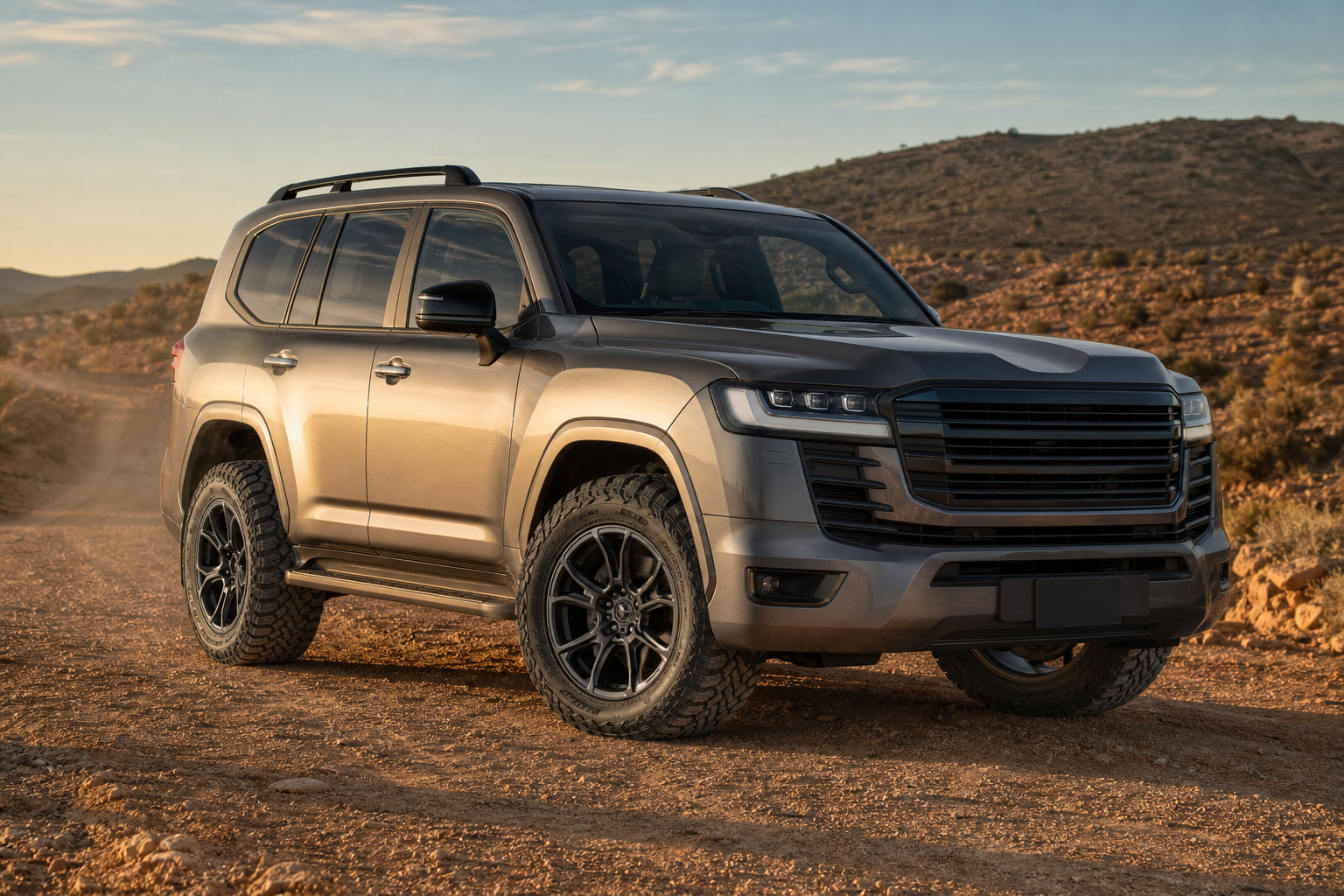
Best Aftermarket Wheels for Toyota LandCruiser 300 Series: Fitment Guide
title: “Best Aftermarket Wheels for Toyota LandCruiser 300 Series: Fitment Guide”
slug: “best-aftermarket-wheels-for-toyota-landcruiser-300-series-fitment-guide”
meta_description: “Toyota LandCruiser 300 Series wheel fitment guide covering bolt pattern, centre bore, offsets, load rating, best wheel sizes, tyre pairing, lift considerations, brake clearance and common mistakes.”
tags:
– Toyota LandCruiser 300 Series
– LandCruiser 300 wheel fitment
– 6×139.7
– 4×4 wheels
– offset
– centre bore
– load rating
category: “Fitment Guides”
—
TL;DR: For most Toyota LandCruiser 300 Series builds, the best aftermarket wheel fitment stays close to the platform’s factory logic rather than fighting it. The key numbers most owners need to know are 6×139.7 PCD, 95.1 mm centre bore, M14x1.5 hardware, and factory-style positive offsets that keep the wheel properly located under a heavy full-size 4WD. In practical terms, 17-inch wheels are mainly for off-road-focused builds where brake clearance has been confirmed, 18-inch wheels are a strong all-round option, and 20-inch wheels make sense for road-biased touring setups when weight, tyre choice and load capacity are handled properly. The LC300 is large and visually forgiving, but it is also heavy, powerful and often used under load, so good fitment is not about chasing the widest or most aggressive setup. It is about clearance, strength, scrub radius, tyre diameter, brake room and real-world suspension travel.

In This Guide
- About the Toyota LandCruiser 300 Series Platform
- Toyota LandCruiser 300 Series Fitment Specs
- Best Wheel Sizes
- Offset and Backspacing Strategy
- Tyre Pairing Guide
- Lift and Suspension Considerations
- Load Rating and Construction
- Brake Clearance and Hardware
- Common Fitment Mistakes
- Legal Compliance
- FAQ
- References
About the Toyota LandCruiser 300 Series Platform
The Toyota LandCruiser 300 Series sits in a very different fitment category from a crossover or lighter dual-cab. It is a large body-on-frame four-wheel drive with serious towing expectations, long-distance touring use, substantial brake hardware, and a kerb weight that quickly becomes much higher once passengers, fuel, recovery gear, luggage and accessories are added. That matters because a wheel that merely bolts onto the hub is not automatically a good wheel for an LC300. The platform asks much more of the complete wheel-and-tyre package than its generous guards might suggest.
One of the biggest mistakes people make with the LC300 is assuming the vehicle’s size means it will accept almost anything. Visually, the body can hide a broad range of fitments. Mechanically, though, the margins are tighter. Brake clearance is a real issue. Inner guard and chassis clearance matter once tyre width and diameter start increasing. Offset changes influence steering feel more noticeably than many owners expect. And because the vehicle is genuinely heavy, wheel strength and load rating are not small-print details. They are fundamental.
The other reason the LC300 deserves a measured approach is that owners use them in very different ways. Some spend most of their lives on sealed roads doing school runs, commuting and highway travel. Some are built for long-range touring with roof loads, drawers, rear carriers and larger tyres. Others tow frequently, which changes suspension attitude and makes stability more important than appearance. A road-biased 20-inch setup that feels perfectly logical on an urban touring vehicle may be the wrong answer entirely on a build that sees rocky tracks and repeated corrugations.
It is also worth remembering that the LC300 already starts with a strong factory baseline. Toyota did not choose its wheel diameters, widths, offsets and tyre sizes randomly. The factory package reflects the vehicle’s brake size, steering geometry, stability systems, intended loads and the need to remain predictable in a very wide range of conditions. That does not mean aftermarket fitment needs to stay identical to stock, but it does mean the smartest upgrades usually work with the platform rather than trying to impose a show-car mindset onto a vehicle that is fundamentally engineered for durability and control.
If you want a refresher on the three measurements that drive almost every wheel choice, start with Wheel Offset, PCD and Centre Bore Explained. For a broader look at how to choose wheel size, construction and intended use, this aftermarket wheel buying guide is also useful background reading.
Toyota LandCruiser 300 Series Fitment Specs
While trim levels can vary in factory wheel diameter and tyre choice, the LC300 follows a broadly consistent hub pattern. You should still confirm the exact factory specification for your own variant before ordering, especially if it has upgraded brakes, factory 20-inch wheels, or region-specific trim differences. As a working baseline, the key fitment numbers are as follows:
- Generation: Toyota LandCruiser 300 Series
- Years: 2021 onwards
- PCD: 6×139.7
- Centre Bore: 95.1 mm
- Stud Thread: M14x1.5
- Common Factory Wheel Diameters: 18-inch and 20-inch depending on trim
- Common Factory Widths: Typically around 8 to 8.5 inches
- Typical Factory Offset: Generally high positive offset, commonly around +55 to +60 depending on wheel
- Typical Factory Tyre Sizes: Often around 265/65R18 or 265/55R20 depending on trim
The main message in those numbers is that the LC300 is not a low-offset platform from the factory. Toyota keeps the wheel mounted relatively inboard compared with many aftermarket 4×4 trends. That affects how you should think about replacements. Moving dramatically lower in offset might look tougher in a static photo, but it also pushes the tyre outward, changes steering leverage, increases the chance of guard interference, and can create a heavier, less resolved feel at the wheel.
The centre bore is also worth respecting. An aftermarket wheel with a larger centre bore can still be used, but it should be supported properly with the correct hub-centric solution where appropriate. On a heavy four-wheel drive, a sloppy approach to centre bore fitment is harder to justify than it is on a lightweight weekend car.
Best Wheel Sizes
17-inch setups
Seventeen-inch wheels are usually chosen on the LC300 for one reason: sidewall. They appeal to owners who want more tyre depth for off-road use, lower inflation pressures, and better impact compliance on rough terrain. In principle, that makes sense. A 17 can be an excellent functional choice on a heavy 4WD. The catch is brake clearance. Not every 17-inch wheel will clear the LC300’s brake package, and not every wheel profile that technically clears in static conditions will remain the right answer once mud, debris, wheel weights and real use are part of the equation.
That is why 17s should be treated as a confirmed-fitment option rather than a default assumption. If brake clearance has been properly checked, a 17×8.5 or similar wheel with an appropriate load rating can make a lot of sense on an off-road or touring build. The larger tyre sidewall improves compliance and helps the vehicle feel less brittle on broken surfaces. But it is only a good choice if the wheel design itself has the right inner barrel and spoke profile to clear the brakes safely.
In other words, 17s can be brilliant on the right LC300 build, but they are the least forgiving diameter from a fitment-confirmation point of view.
18-inch setups
For many owners, 18 inches is the sweet spot. It preserves useful sidewall, usually makes brake clearance easier than a 17, and still gives the vehicle a strong, planted look without making it feel too road-biased. It also keeps tyre choice broad in the all-terrain and highway-terrain categories, which matters if the vehicle has to handle commuting, touring and rougher surfaces without needing separate wheel sets.
A typical LC300 all-round fitment window is 18×8.5 to 18×9 with a sensible positive offset. That gives enough width to support common 265- and 285-section tyres without turning the vehicle into something nervous or cumbersome. For owners who want one setup that genuinely works across everyday driving, long trips and moderate off-road use, 18s are very hard to beat.
The strength of an 18-inch LC300 setup is balance. The wheel can still look substantial under the body, but the tyre does enough work that the vehicle retains some compliance, rim protection and touring practicality. That is exactly why 18s remain so popular on large 4WDs that actually get used.
20-inch setups
Twenty-inch wheels are completely logical on the LC300 when the build is more road-focused and the owner wants to stay close to certain factory-style appearances. Toyota itself has used 20-inch fitment on some variants, which tells you that the diameter itself is not inherently wrong for the platform. The important question is whether the rest of the package still suits how the vehicle is driven.
A well-chosen 20×8.5 or 20×9 can work very well on an urban touring or highway-led build, particularly if tyre load rating, wheel weight and offset are kept sensible. The downside is the smaller sidewall. Once the tyre gets shorter, the vehicle tends to feel firmer over sharp edges and less relaxed on poor surfaces. That may be completely acceptable for an owner who spends almost all of their time on sealed roads. It is less attractive for someone planning extended rough travel.
Twenty-inch fitment therefore makes the most sense when the priority is road presentation and sealed-road response, not maximum sidewall and trail durability.
22-inch setups
Twenty-twos are possible, but on most LC300s they fall into the style-first category. The body can physically carry them visually, yet the tyre compromise becomes much harder to justify on a vehicle designed for load, travel and terrain versatility. Ride quality, rim protection and impact tolerance all move the wrong way as diameter rises and sidewall shrinks.
That does not make 22s impossible. It simply means they are rarely the best engineering answer. On a heavy SUV that may still see potholes, broken surfaces or towing duty, the smarter fitment almost always sits below that point.
Best all-round recommendation
If I had to give one broad recommendation for the majority of LC300 owners, it would be this: 18×8.5 to 18×9 with a conservative positive offset and a tyre size that stays close to the vehicle’s intended gearing and clearance balance is usually the strongest all-round window. It looks right, works well under load, and avoids many of the downsides that appear when owners chase either extreme sidewall or extreme diameter without thinking through the whole system.
Offset and Backspacing Strategy
Offset matters enormously on the LC300 because it controls more than appearance. It changes how far the wheel sits inboard or outboard, which in turn affects guard clearance, scrub radius, steering effort, bearing load and how much the tyre throws mud and debris along the body. On a heavy 4WD, these are not academic details.
The factory setup uses a relatively high positive offset for good reasons. It keeps the wheel centreline where Toyota wanted it relative to the steering axis and suspension geometry. Once you move to a substantially lower offset, the wheel sits further outward. That often creates the “wider track” look many owners like, but it can also make the steering feel heavier, increase kickback off-road, and create rubbing at the outer guards even if inner clearance improves.
That is why the LC300 generally responds best to moderation. A mild reduction in offset can give the vehicle a more assertive stance without upsetting everything else. A dramatic reduction may create a more aggressive visual result, but it often carries hidden costs that only show up after the vehicle is loaded, lifted, aligned and driven properly.
Backspacing is the other half of the picture. Two wheels with the same nominal width can behave differently depending on actual inner barrel shape and offset. On the LC300, backspacing is especially relevant around the upper control arm, inner liner and brake package. It is not enough to say “this width fits” in the abstract. You need to know where the wheel and tyre are moving in relation to the whole front-end assembly.
If you want the safest path, stay close to the factory fitment logic, make incremental changes, and treat every extra step outward as something that must justify itself in terms of function rather than just visual attitude.
Tyre Pairing Guide
Tyres define how the LC300 feels at least as much as the wheels do. On this platform, tyre choice influences road noise, steering precision, braking, wet grip, impact harshness, off-road traction, fuel use and gearing behaviour. Because the vehicle is heavy and often loaded, it also influences stability in a very real way. This is why wheel fitment can never be separated from tyre fitment on a LandCruiser.
For many factory-based setups, 265-width tyres remain the most straightforward match. They preserve predictable clearance, steering feel and rolling resistance while still giving the vehicle the footprint Toyota intended. For owners wanting a slightly fuller stance or more off-road bias, 285-width tyres are commonly considered, but they demand much more care. The tyre may be labelled only 20 mm wider, yet real-world section width, shoulder shape and actual mounted diameter can change the fitment picture dramatically.
The most important principle is to respect total diameter. A small change may be manageable. A large jump can affect gearing, speedometer accuracy, transmission behaviour, stability systems and clearance at the body mount, liner or mud flap under articulation. Bigger is not free. The LC300 has torque, but that does not mean every oversized tyre is a sensible idea.
Highway and touring tyres
For daily driving, long-distance highway work and towing, a quality highway-terrain or touring all-terrain tyre often suits the LC300 best. These tyres tend to keep noise down, maintain stable steering and avoid making the vehicle feel lazy or coarse. They are often the best fit for 18- and 20-inch road-biased setups where refinement matters as much as appearance.
All-terrain tyres
All-terrains make sense when the vehicle genuinely sees gravel, tracks, rocks or variable surfaces. The problem is that all-terrain tyres are often larger and squarer in the shoulder than their nominal size suggests. That means a 285 all-terrain can behave like a much bigger step than a 285 road tyre. On the LC300, this can affect full-lock clearance, liner contact and the room available once the suspension compresses off-road.
Square setups
The LC300 should almost always run a square setup. Matching front and rear wheel and tyre sizes makes rotation easier, keeps the spare more useful, and preserves predictable handling. A staggered setup adds complexity for almost no practical benefit on a heavy four-wheel drive. If you want the deeper reasoning, this guide to staggered wheel setups explains why it rarely makes sense outside the right rear-drive context.
Lift and Suspension Considerations
A lift does not magically solve fitment. It changes it. That distinction matters on the LC300 because many owners lift the vehicle and then assume tyre clearance is no longer a real constraint. In practice, a lift may create more static room in the guard, but the tyre still travels through the same steering arc and can still contact liners, mud flaps, body mounts or chassis points depending on offset and actual tyre dimensions.
The front end is where most of the important decisions show up. Once wheel width increases, offset decreases and tyre diameter grows, clearance becomes a three-dimensional problem rather than a simple “will it fit under the guard” question. Full steering lock matters. Compression matters. Alignment matters. If the vehicle is fitted with aftermarket upper control arms or changed bump stop settings, those details matter too.
Suspension choice also affects how much rubbing you are willing to tolerate. A setup that only brushes the liner at full lock in a car park might be unacceptable on a daily driver, even if an off-road-focused owner considers it manageable. The right answer depends on use, but the important point is to test under realistic conditions rather than relying on parked measurements.
Load changes the story as well. Touring gear, roof loads, rear drawers, water, fuel and towing download all alter how the vehicle sits and moves. An LC300 that clears easily when empty can behave very differently once it is packed for a trip. That is exactly why good fitment on this platform is about real operating conditions, not just showroom stance.
Load Rating and Construction
Load rating is one of the most overlooked parts of LC300 wheel selection, and it should be one of the first things checked. This is not a light passenger car. It is a heavy 4WD often used with passengers, cargo, accessories and trailers. A wheel that looks right but carries an inadequate load rating is the wrong wheel, full stop.
Construction matters too. A very heavy cast wheel can dull the LC300’s ride and steering, especially in larger diameters. That does not mean cast wheels are automatically bad. It means actual weight and actual rating matter more than marketing language. A properly engineered wheel with a suitable load capacity is far more important than a generic promise of toughness.
Flow formed wheels can be attractive where they deliver a useful strength-to-weight balance, but rating still comes first. Forged wheels can offer excellent strength and lower mass, though they are usually chosen at the higher end of the market. Regardless of construction method, the LC300 rewards wheels that are strong, correctly rated and not unnecessarily heavy.
If you want a broader primer on manufacturing differences, this cast vs forged wheel guide is worth reading. Just keep in mind that on the LC300, the conversation always needs to include real load capacity, not just how the wheel was made.
Brake Clearance and Hardware
Brake clearance is the LC300 fitment topic that catches people out most often, especially when chasing smaller wheel diameters. The issue is not only barrel diameter. Spoke profile and caliper face clearance matter as well. One 17-inch wheel may clear while another 17-inch wheel of the same nominal size does not. That is why brake templates, confirmed test fits or proven application data matter more here than generic internet confidence.
Hardware also deserves attention. The LC300 uses M14x1.5 studs, so the nut seat type and thread engagement must match the wheel exactly. Do not assume that because a nut threads on, it is correct. Seat type, shank length where applicable, and proper torque all matter on a vehicle that may carry serious mass over broken surfaces.
If the wheel uses a larger centre bore than the Toyota hub, make sure the installation is properly hub-centric where required. On some platforms people get away with being casual about centre bore fit. The LC300 is not a platform where that attitude makes sense.
Common Fitment Mistakes
- Ignoring load rating: Strength and capacity are non-negotiable on a heavy full-size 4WD.
- Assuming every 17-inch wheel clears the brakes: Diameter alone does not guarantee safe caliper clearance.
- Dropping offset too aggressively: The tough look can come with worse steering feel, rubbing and more stress on the whole system.
- Choosing tyre size by label only: Actual dimensions vary between brands and tread patterns.
- Forgetting the spare: If the vehicle is used remotely, the spare needs to remain practical and compatible.
- Planning fitment with the vehicle empty: The LC300 is often driven loaded, and that changes real clearance.
- Overweight wheel choices: Added unsprung mass is very noticeable on a vehicle this size.
- Treating lift height as the whole answer: Steering sweep and articulation still matter after a lift.
- Using the wrong hardware: Stud pattern, nut seat and centre bore support all need to be correct.
Legal Compliance
Wheel and tyre laws vary by market, so there is no single LC300 setup that can be assumed compliant everywhere. The safest approach is to keep rolling diameter changes within sensible limits, use tyres with suitable load and speed ratings, and ensure the complete package clears suspension, steering and bodywork through the full range of movement.
Tyres should remain properly covered by the bodywork as required in the market where the vehicle is driven, and any changes to track width, offset, ride height or tyre diameter should be checked against local roadworthiness rules. A combination that physically fits is not automatically legal, safe or wise.
This is especially important on the LC300 because the vehicle is so often used for towing and long-distance travel. Conservative, well-measured fitment nearly always ages better than an aggressive setup built around appearance alone.
FAQ
What bolt pattern does the Toyota LandCruiser 300 Series use?
The LC300 commonly uses a 6×139.7 bolt pattern. You should still confirm your exact vehicle before ordering wheels.
What is the centre bore on the LandCruiser 300?
The commonly referenced centre bore is 95.1 mm. If an aftermarket wheel has a larger bore, the fit should be properly supported.
What stud pattern and thread does the LC300 use?
The platform commonly uses six studs with M14x1.5 thread. Correct nut seat type and proper torque still matter just as much as thread size.
What is the best all-round wheel size for a LandCruiser 300 Series?
For most owners, 18×8.5 to 18×9 with a sensible positive offset is the strongest all-round window because it balances sidewall, brake clearance, touring practicality and stance.
Can I fit 17-inch wheels to a LandCruiser 300?
Sometimes, but not every 17-inch wheel will clear the brakes. On the LC300, 17-inch fitment should always be treated as a confirmed-brake-clearance setup rather than an assumption.
Are 20-inch wheels okay on the LC300?
Yes, especially for road-focused and highway-oriented builds. The main trade-off is reduced sidewall, which can make the vehicle feel firmer and less forgiving on rough surfaces.
What tyre width works best on a Toyota LandCruiser 300?
Many factory-style builds work very well with 265-width tyres. A 285-width tyre can also work, but it usually needs much closer attention to offset, actual tyre dimensions and clearance at full lock and compression.
Does a lift kit guarantee bigger tyres will fit?
No. A lift changes static height, but it does not remove steering sweep, articulation or inner clearance limits. Bigger tyres still need to be checked carefully.
Do wheel load ratings really matter on the LC300?
Absolutely. The LC300 is a heavy vehicle often used under load, so wheel load rating is one of the most important filters when choosing aftermarket wheels.
Should I run a staggered setup on a LandCruiser 300?
No, in almost every case a square setup is the better choice. It keeps handling predictable, makes tyre rotation easier and ensures the spare remains more useful.
References
- Toyota LandCruiser 300 Series manufacturer specifications and owner documentation for trim-specific wheel and tyre data
- Independent fitment databases used as cross-reference points for PCD, centre bore, hardware and factory wheel sizing
- Kaizen Wheels guides on offset, centre bore, wheel construction and staggered fitment for general wheel selection principles
PHP: 2026-04-20 01:05:12 [notice X 0][/home/mensring/kaizenwheels.com.au/wp-content/plugins/elementor-pro/modules/forms/submissions/actions/save-to-database.php::193] {closure:ElementorProModulesFormsSubmissionsActionsSave_To_Database::__construct():193}(): Implicitly marking parameter $exception as nullable is deprecated, the explicit nullable type must be used instead [array (
‘trace’ => ‘
#0: ElementorCoreLoggerManager -> shutdown()
‘,
)]

