
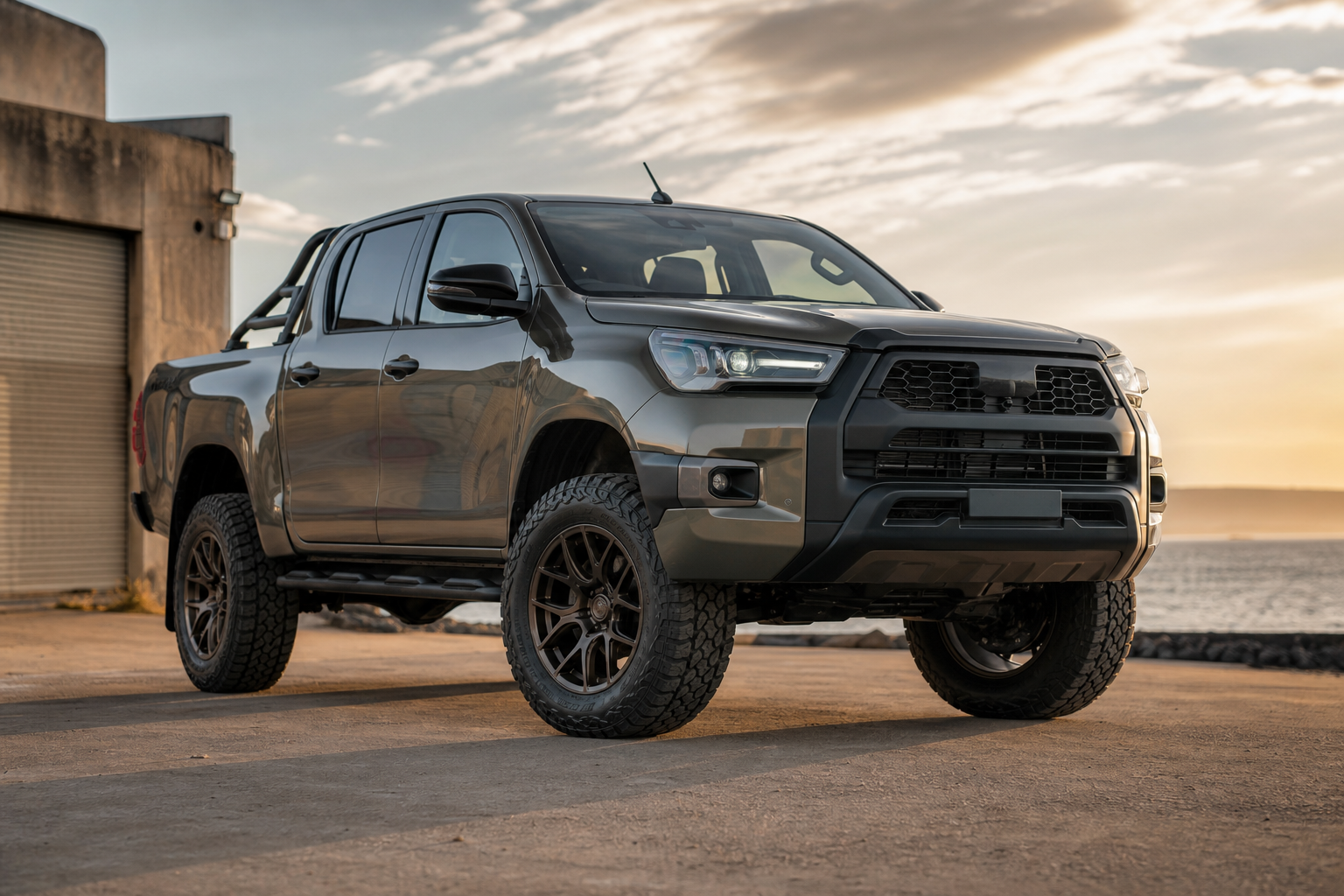
Best Aftermarket Wheels for Toyota HiLux (Rogue/Rugged X): Fitment Guide
title: “Best Aftermarket Wheels for Toyota HiLux (Rogue/Rugged X): Fitment Guide”
slug: “best-aftermarket-wheels-for-toyota-hilux-rogue-rugged-x-fitment-guide”
description: “A detailed fitment guide to choosing aftermarket wheels for the Toyota HiLux Rogue and Rugged X, covering bolt pattern, centre bore, offsets, wheel sizes, tyre pairing, clearance, load rating, and common mistakes.”
keywords:
– Toyota HiLux Rogue wheel fitment
– Toyota HiLux Rugged X wheels
– HiLux bolt pattern
– HiLux offset guide
– aftermarket wheels for HiLux
—
Best Aftermarket Wheels for Toyota HiLux (Rogue/Rugged X): Fitment Guide
The Toyota HiLux Rogue and Rugged X sit near the more premium, more visually assertive end of the HiLux range. They already carry wider guards, chunkier tyre packages, and a stance that looks more deliberate than a basic work-spec ute. That makes wheel fitment slightly more nuanced than it is on a standard pickup: if you change the wheels, the new setup needs to work with the vehicle’s size, weight, suspension geometry, steering travel, brake clearance, and the visual balance created by the factory bodywork.

This guide focuses on fitment first. It is not about trend-chasing or forcing the biggest wheel possible under the arches. The aim is to help you choose aftermarket wheels that suit how the HiLux Rogue or Rugged X is actually used, whether that means long-distance road driving, mixed on-road and off-road use, towing, touring, or simply building a cleaner and more purposeful stance without introducing rubbing, vibration, or unnecessary compromises.
If you are still getting your head around the core terminology, it is worth reading Ensuring Wheel Fitment: How to Make Sure Aftermarket Wheels Fit Your Vehicle and Wheel Size Explained: Diameter, Width & How They Change Your Car’s Performance alongside this guide. The concepts there apply directly to the Rogue and Rugged X.
Why the Rogue and Rugged X need a model-specific fitment approach
Although they share the broader HiLux platform, the Rogue and Rugged X are not simply base-model variants with extra trim. These versions tend to be paired with more aggressive factory tyres, wider tracks, and body styling that changes how wheel poke and tyre shoulder sit relative to the guards. That matters because a wheel fitment that technically bolts onto another HiLux may still look wrong, sit too far inboard, push too far outward, or create clearance issues under compression on the Rogue or Rugged X.
These vehicles also live in a use case where load rating and durability matter. A sporty passenger car can sometimes get away with very appearance-driven fitment. A HiLux cannot. If the ute carries tools, camping gear, recovery equipment, passengers, or trailer weight, the wheel choice needs to preserve the mechanical integrity of the package. Fitment is not just about whether the studs line up. It is about whether the entire wheel and tyre combination makes sense for the vehicle’s mass and intended use.
Core wheel fitment specs for Toyota HiLux Rogue and Rugged X
Before looking at styles or diameters, start with the hard measurements. The key factory-style fitment points for the HiLux Rogue and Rugged X are typically:
- Bolt pattern (PCD): 6×139.7
- Centre bore: 106.1 mm
- Stud thread: commonly M12 x 1.5
- Typical factory wheel diameter: 18 inches on many Rogue and Rugged X variants
- Typical factory wheel width: around 7.5 inches
- Typical factory offset zone: roughly around +30, depending on exact year and market configuration
You should still confirm the exact factory wheel and tyre placard information for the specific vehicle in front of you. Model year changes, market variations, special editions, tyre package revisions, and dealer-installed accessories can all affect what is currently on the vehicle and how much clearance margin you really have.
Understanding what these numbers mean on a HiLux
The 6×139.7 bolt pattern is common in the pickup and 4×4 world, which is helpful because it opens up a broad wheel selection. But having the correct PCD does not guarantee proper fitment. A wheel can share the same stud pattern and still be wrong because the centre bore is too small, the offset is too aggressive, the inner barrel shape conflicts with the brake hardware, or the load rating is inadequate.
The 106.1 mm centre bore matters because the HiLux is designed around that hub size. A wheel with a smaller centre bore will not seat properly. A wheel with a larger centre bore can be used if the design is correct and the wheel is properly centred, but it should still be approached carefully because a large mismatch introduces more opportunity for poor centring and vibration if the overall package is not engineered properly. If you want a deeper explanation of why this matters, Wheel Hardware & Fitment Essentials: Centre Bore, Hub-Centric Fitment, Bolts, Nuts & Spacers is useful background reading.
Best aftermarket wheel diameters for the HiLux Rogue and Rugged X
17-inch wheels
A 17-inch wheel is one of the most practical sizes for a HiLux that sees serious mixed use. Moving to a 17 can create more tyre sidewall for the same overall rolling diameter, which is often desirable for rough surfaces, lower-pressure work, and a more forgiving ride. It can also visually suit the Rogue and Rugged X if you want a tougher, more functional look rather than a road-focused one.
The main thing to verify is brake clearance. While many 17-inch aftermarket wheels fit over HiLux brakes, not every design does. Barrel profile and spoke shape matter as much as diameter. On these vehicles, 17s usually make the most sense when the goal is durability, sidewall compliance, and all-terrain versatility rather than a larger visual statement.
18-inch wheels
For many owners, 18 inches is the sweet spot. It preserves the character of the factory package, keeps brake clearance straightforward, and gives you a strong selection of all-terrain and road-biased tyre options. The Rogue and Rugged X already wear 18-inch factory-style packages comfortably, so staying at 18 often means fewer compromises and a more predictable fitment outcome.
If you want the vehicle to look more resolved and premium without upsetting the balance of ride quality, steering feel, and practical tyre choice, 18×8.5 is usually one of the strongest starting points.
20-inch wheels
Twenty-inch wheels can work on the Rogue and Rugged X, particularly if the build is more street-oriented and the goal is a sharper, more modern look. But the trade-offs become clearer here. Tyre sidewalls get shorter, ride firmness increases, impact harshness rises, and off-road flexibility is reduced. On a heavy ute, these changes are not subtle.
If a 20-inch setup is chosen, offset, tyre diameter, and load rating need extra scrutiny. This is not the size to choose casually just because it fills the guards.
Best wheel widths for a balanced fitment
8.0 inches wide
An 8.0-inch width is conservative, practical, and easy to pair with common tyre sizes. It keeps the tyre profile relatively well supported without getting too aggressive at the guard line. This width is especially useful if you want a near-factory driving feel and do not need an especially wide footprint.
8.5 inches wide
For most aftermarket HiLux builds, 8.5 inches is a strong middle ground. It offers enough width to support popular all-terrain and road-terrain tyre sizes, improves stance potential, and still remains easy to work with from a clearance perspective. On the Rogue and Rugged X, 18×8.5 is often one of the most sensible aftermarket starting points.
9.0 inches wide
A 9.0-inch wheel can work well if the rest of the package is chosen carefully, but it begins to push the setup toward a more assertive stance. At this width, offset selection becomes more critical. A wheel that is too positive can sit awkwardly tucked; too low an offset can push the tyre shoulder outward enough to create rubbing or unwanted scrub, especially once tyre tread blocks get more aggressive.
Offset: the most important choice after bolt pattern
Offset determines where the wheel sits in relation to the hub. On the HiLux Rogue and Rugged X, this is the number that most strongly shapes the stance, steering behaviour, scrub radius, guard relationship, and likelihood of rubbing.
As a general guide:
- Higher positive offsets pull the wheel further inward.
- Lower positive offsets push the wheel further outward.
- Very aggressive low offsets may create a broader stance, but also increase the chance of tyre poke, guard contact, steering interference, and greater bearing and steering load.
For many Rogue and Rugged X owners, the useful aftermarket zone often sits somewhere in the approximately +20 to +30 range on widths around 8.0 to 8.5 inches, depending on tyre size and intended look. If the aim is a tidy, functional fitment with minimal drama, that zone is usually where the conversation starts.
Dropping further toward offsets like +12, +10, or below may create a more aggressive visual stance, but it also increases the chance of rubbing the outer guards, mud flaps, liner edges, or body mount areas depending on tyre size and suspension position. It can also alter steering feel in ways that may not be welcome on a vehicle used for distance driving or towing.
Offset should never be chosen in isolation. An 18×8.5 +25 and a 17×9 +20 are not equivalent just because the offset numbers seem close. Width changes where the inner and outer lips sit, so every fitment must be assessed as a complete package.
Tyre pairing: the wheel is only half the fitment story
Many wheel fitment mistakes happen because people think in wheel sizes only. In reality, tyre section width, sidewall profile, tread design, and actual measured casing shape matter just as much. Two tyres with the same labelled size can sit differently depending on the brand and tread pattern.
Common pairings that often make sense on the HiLux Rogue and Rugged X include:
- 17×8.0 or 17×8.5 with a tyre sized to preserve useful sidewall and near-factory rolling diameter
- 18×8.0 or 18×8.5 with a tyre that keeps overall diameter close to stock for straightforward daily usability
- 20×8.5 or 20×9.0 only when the build is intentionally road-focused and the reduction in sidewall suits the use case
If you increase tyre diameter meaningfully, you gain ground clearance and visual presence, but you also increase the chance of rubbing at the front guards, liners, mud flaps, and rear of the front wheel arch during turning and compression. If you increase width and reduce offset at the same time, those risks compound quickly.
Will bigger wheels or tyres rub on a Rogue or Rugged X?
Possibly, yes. These models may look ready for a very aggressive wheel and tyre package from the factory, but the available clearance is still finite. Rubbing usually depends on a combination of five factors:
- Wheel width
- Wheel offset
- Tyre width
- Tyre overall diameter
- Suspension height and compression behaviour
A setup that clears at static ride height can still rub on steering lock, under braking dive, over dips, or when the front suspension compresses diagonally off-road. This is why test fitting, or at minimum comparing inner and outer clearance changes mathematically, matters so much on utes.
In practical terms, a mild fitment close to factory diameter with a sensible offset is generally straightforward. Problems usually begin when owners chase all three of the following at once: a wider wheel, a more outward offset, and a taller all-terrain tyre.
Brake clearance and barrel shape
On the HiLux, brake clearance is not only about wheel diameter. Spoke design, mounting pad thickness, and the shape of the inner barrel all affect whether the wheel clears the front brake package. A 17-inch wheel from one design family may clear easily while another 17 of the same nominal width and offset may not.
This is one reason generic fitment lists should be treated as a starting point rather than a final answer. The vehicle may accept the size on paper, but the specific wheel design still needs to be checked against the brakes.
Load rating is not optional
One of the most overlooked parts of 4×4 and pickup wheel selection is load rating. The HiLux Rogue and Rugged X are not lightweight passenger cars. Even before cargo, passengers, accessories, and trailer download are factored in, the wheel needs to be appropriate for a working vehicle platform.
That means the wheel should have a genuine load rating suitable for the axle loads and intended use of the vehicle. A wheel that is technically the right size but carries a passenger-car-style rating is the wrong wheel. If the vehicle tows, carries tools, travels long distances loaded, or spends time on poor surfaces, this becomes even more important.
Best fitment directions depending on how the vehicle is used
1. Daily road use with occasional rough-surface driving
The best approach is usually to stay close to the factory overall diameter, keep offsets moderate, and choose either a 17 or 18-inch wheel in 8.0 to 8.5-inch width. This preserves predictable steering and minimises clearance surprises.
2. Touring and mixed-use 4×4 driving
A 17-inch wheel often makes strong sense here because it allows more sidewall. An 8.0 or 8.5-inch width with a practical offset and a tyre that does not push the overall diameter too far beyond stock tends to deliver the most usable real-world result.
3. Street-focused appearance build
If appearance is the priority and off-road flexibility matters less, an 18 or 20-inch package can work well. The key is keeping the fitment visually assertive without introducing an unnecessarily harsh ride or exaggerated poke that looks forced against the guards.
Common mistakes HiLux owners make when choosing wheels
Choosing offset for appearance only
A wheel that sits more flush is not automatically better. The right offset is the one that gives the vehicle the stance you want while preserving usable clearance and sensible steering geometry.
Ignoring tyre reality
People often say a wheel size fits when what they really mean is that their tyre fit. Change the tyre brand, tread, or diameter and the result can be completely different.
Assuming all 17s or all 18s clear the brakes
Diameter alone is never the full story. Always consider the wheel design itself.
Forgetting load rating
This is one of the biggest errors on pickups and 4x4s. Strength and suitability matter as much as style.
Going too big too quickly
A larger wheel with a taller tyre and more aggressive offset may look impressive in photos, but the compound effect can make the vehicle less pleasant and less practical in normal use.
Recommended fitment mindset for the Rogue and Rugged X
If you want the safest place to start, think in terms of 17×8.0 to 18×8.5, with moderate positive offset, correct 6×139.7 PCD, correct centre bore compatibility, and an appropriate load rating. That general zone suits the platform well because it respects what the vehicle is: a medium-size pickup designed to work, travel, and carry weight, not just pose.
From there, decide what you value most:
- More sidewall and off-road compliance: lean toward 17s
- Balanced factory-plus look: lean toward 18s
- Sharper road-biased appearance: consider 20s carefully
The best aftermarket wheels for a HiLux Rogue or Rugged X are not simply the widest or most aggressive. They are the ones that respect the vehicle’s mechanical needs and the way it is actually driven.
Final thoughts
The Toyota HiLux Rogue and Rugged X respond well to aftermarket wheels when the fitment is thought through properly. The platform offers enough flexibility to support very different outcomes, from functional touring setups to cleaner road-focused builds, but the margin for error narrows once you start combining wider wheels, lower offsets, and larger tyres.
Get the fundamentals right: 6×139.7 bolt pattern, correct centre bore strategy, sensible width, moderate offset, brake clearance, proper tyre pairing, and adequate load rating. If those pieces are handled correctly, the finished result will usually look better, drive better, and cause fewer problems long term than a setup chosen purely for visual impact.
Frequently Asked Questions
What bolt pattern does the Toyota HiLux Rogue or Rugged X use?
These models typically use a 6×139.7 bolt pattern. Even so, bolt pattern alone is not enough to confirm fitment. Offset, centre bore, brake clearance, and load rating still need to be checked.
What centre bore do I need for a HiLux Rogue or Rugged X?
The common hub bore for these HiLux variants is 106.1 mm. Wheels with a smaller bore will not fit correctly. Wheels with a larger bore require proper centring strategy and should be chosen carefully.
Are 17-inch wheels good for a HiLux Rogue or Rugged X?
Yes, in many cases 17-inch wheels are an excellent choice, especially for mixed-use and off-road-oriented driving. They usually allow more tyre sidewall and can improve ride compliance, provided the wheel design clears the brakes.
Are 18-inch wheels the best all-round option?
For many owners, yes. Eighteens tend to offer a strong balance of appearance, brake clearance, tyre availability, and everyday drivability. They are often the easiest size to work with on these premium HiLux variants.
Can I fit 20-inch wheels to a HiLux Rogue or Rugged X?
Yes, but they make the most sense on builds that prioritise road use and appearance. They reduce sidewall height, usually ride firmer, and offer less flexibility for rough-surface driving.
What offset works best on the HiLux Rogue and Rugged X?
That depends on wheel width and tyre size, but moderate positive offsets are usually the safest starting point. On 8.0 to 8.5-inch-wide wheels, a zone around +20 to +30 is often a sensible place to begin assessing fitment.
Will lower offset wheels rub?
They can. As the wheel moves outward, the tyre gets closer to the guard line and can contact liners, mud flaps, or bodywork under steering lock or suspension compression, especially if tyre diameter is also increased.
Do I need to worry about load rating on aftermarket wheels?
Absolutely. The HiLux is a working vehicle platform, and wheel load rating is critical. Always choose wheels with a rating suitable for the vehicle’s axle loads and intended use, especially if carrying gear or towing.
Can I use wheels from another 6×139.7 vehicle?
Not automatically. Matching the PCD is only one part of the equation. The wheel also needs the right centre bore, offset, brake clearance, hardware compatibility, and load rating for the HiLux.
What is the safest approach if I want a better stance without problems?
Stay close to factory overall tyre diameter, choose a moderate-width wheel, avoid extreme offsets, and verify both inner and outer clearance before buying. A mild, well-calculated fitment usually delivers the best real-world result.
PHP: 2026-04-20 01:04:30 [notice X 0][/home/mensring/kaizenwheels.com.au/wp-content/plugins/elementor-pro/modules/forms/submissions/actions/save-to-database.php::193] {closure:ElementorProModulesFormsSubmissionsActionsSave_To_Database::__construct():193}(): Implicitly marking parameter $exception as nullable is deprecated, the explicit nullable type must be used instead [array (
‘trace’ => ‘
#0: ElementorCoreLoggerManager -> shutdown()
‘,
)]

