

Best Aftermarket Wheels for Mazda RX-8: Fitment Guide
title: “Best Aftermarket Wheels for Mazda RX-8: Fitment Guide”
slug: “best-aftermarket-wheels-for-mazda-rx-8-fitment-guide”
meta_description: “Mazda RX-8 wheel fitment guide covering 5×114.3 specs, 67.1 mm centre bore, offsets, square vs staggered setups, tyre sizing, brake clearance, lowering, and the best 17-inch, 18-inch, and 19-inch aftermarket wheel options.”
tags:
– Mazda RX-8
– RX-8 wheel fitment
– 5×114.3
– offset
– centre bore
– rotary
– sports coupe
category: “Fitment Guides”
—
Best Aftermarket Wheels for Mazda RX-8: Fitment Guide
TL;DR: The Mazda RX-8 uses a 5×114.3 PCD, 67.1 mm centre bore, and typically responds best to lightweight 17-inch or 18-inch wheels. For most owners, 18×8.5 to 18×9.5 is the sweet spot, usually with offsets around +38 to +45 depending on tyre size, suspension height, and whether the car runs a square or near-square setup. A well-chosen RX-8 wheel package should preserve steering feel, maintain clearance around the guards and suspension, and avoid unnecessary weight. The platform rewards balance, not excess.
In This Guide
- About the Mazda RX-8 Platform
- Factory Wheel Specs
- Best Aftermarket Wheel Sizes
- Square vs Staggered Setups
- Brake Clearance, Hub Details, and Hardware
- Suspension and Lowering Considerations
- Stance Options
- Wheel Construction and Weight
- Tyre Pairing Guide
- Common Fitment Mistakes
- Legal and Road Compliance
- FAQ
- References
About the Mazda RX-8 Platform
The Mazda RX-8 is one of those cars where wheel fitment matters for more than appearance. The chassis is light on its feet, the steering is communicative, the suspension geometry is more sophisticated than many people realise, and the car’s overall balance is a major part of why it still feels special. When you choose the right wheels, the RX-8 feels sharper, more composed, and more resolved. Choose badly, and the car can feel heavy, nervous, or oddly disconnected from the road.
That sensitivity comes from the design of the car itself. The RX-8 was engineered around a compact rotary engine, front-midship weight distribution, and a chassis that values agility over brute force. It is not a platform that hides poor wheel choices behind a soft suspension tune or oversized body. Changes in wheel diameter, width, offset, and tyre construction all show up clearly in the way the car steers and rides.
Visually, the RX-8 also has very specific proportions. The body is sleek, low, and slightly delicate compared with later turbocharged performance coupes. That means oversized wheels can look out of place very quickly. The car generally suits fitments that look intentional and athletic rather than exaggerated. In practical terms, that usually means prioritising width, offset, and weight over chasing the biggest diameter possible.
From a technical standpoint, the platform is friendly enough to work with once the fundamentals are clear. The key factory points are 5×114.3 PCD, 67.1 mm centre bore, and M12x1.5 hardware. Those numbers open up a wide range of wheel options, but bolt pattern alone is never enough. Offset, spoke shape, barrel design, tyre profile, and suspension height still determine whether a package is genuinely well sorted.
If you want a refresher on the core terminology before deciding on offsets and widths, Kaizen’s guide to wheel offset, PCD and centre bore is worth reading first. It will make the rest of the RX-8 fitment conversation much easier to follow.
Factory Wheel Specs
The RX-8 was sold in several trims and update phases, so exact factory wheels vary, but the core fitment fundamentals stay consistent across the platform. That consistency is helpful because it gives owners a reliable baseline for aftermarket planning.
Shared Platform Specs
- PCD: 5×114.3
- Centre Bore: 67.1 mm
- Stud Thread: M12x1.5
- Common Factory Diameters: 16-inch, 17-inch, and 18-inch depending on trim
- Typical Factory Offset: Usually around +50 on OEM 18-inch wheels
Many enthusiasts think of the RX-8 as an 18-inch car because the better-known versions often came with factory 18s. That is understandable, but it is useful to remember that Mazda did not build the platform around one fixed wheel formula. Some versions ran smaller wheels, and that matters because it confirms the chassis can work well with more than one diameter if the overall package stays coherent.
Typical OEM 18-inch Fitment
- Front: commonly 18×8 +50 with 225/45R18 tyres
- Rear: commonly 18×8.5 +50 with 245/40R18 tyres
- Notes: factory setups often use a slight width difference front to rear, but the offsets remain conservative and the overall balance stays mild.
This is an important reference point. The OEM fitment tells you Mazda wanted a restrained, drivability-first package with plenty of clearance margin. It also shows that the car can physically accept useful width from factory without needing extreme offsets. The factory wheel position is tucked by aftermarket standards, but it is not accidental. Mazda chose that spec to preserve steering feel, bump clearance, and a clean relationship between the tyre and the arch.
What the Factory Specs Teach You
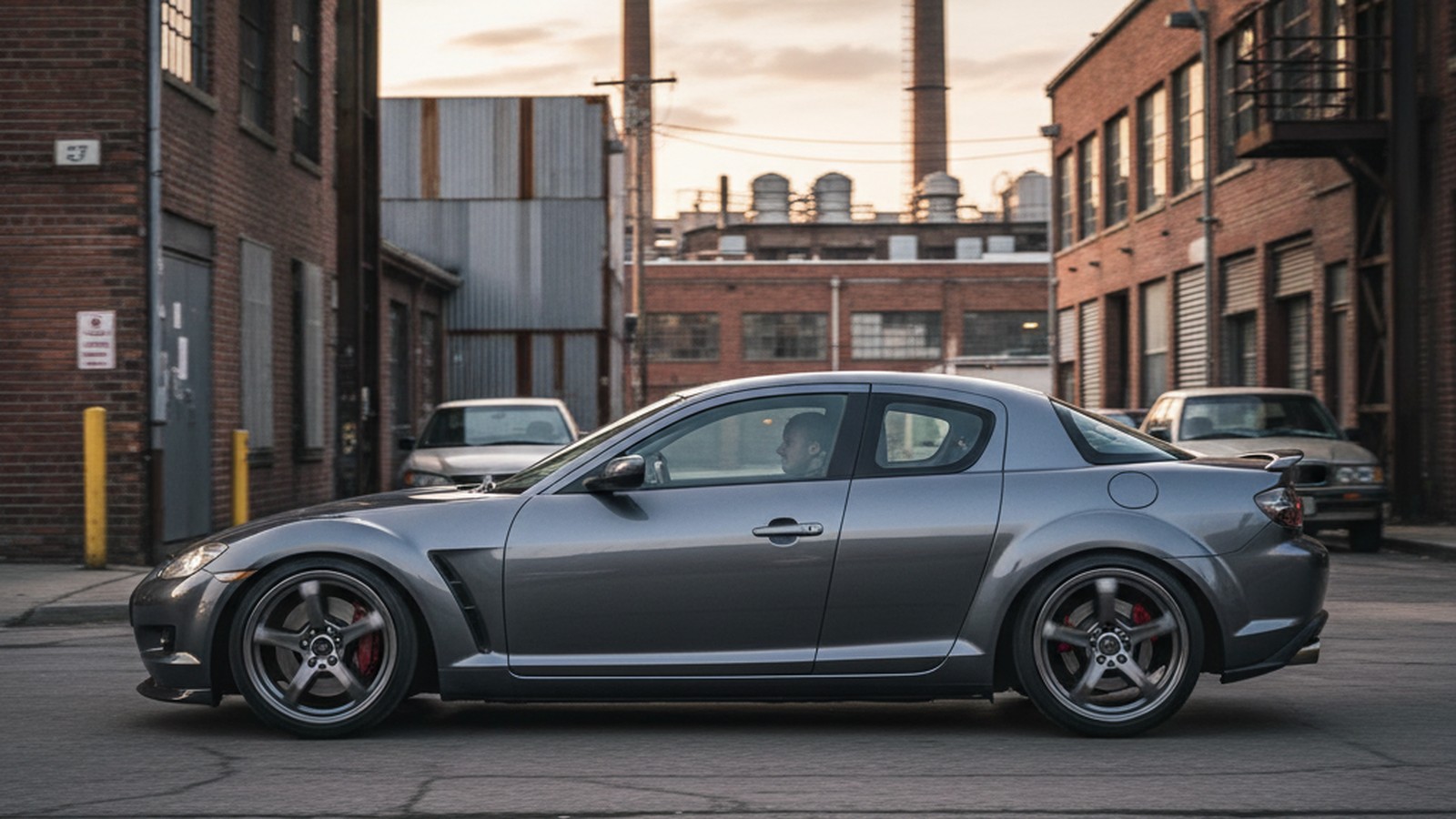
The RX-8 does not need a dramatic wheel package to look right. It needs a package that respects three things: the relatively tight front end, the car’s preference for low unsprung mass, and the fact that ride and steering quality change noticeably with tyre sidewall and offset. That is why the best aftermarket fitments are usually not wildly different in concept from factory. They simply refine the stance, add useful width, and reduce unnecessary wheel weight.
That approach is especially important if the car is street driven. It is easy to build an RX-8 that looks more aggressive parked. It is harder, and much more worthwhile, to build one that still feels fluid and precise at speed.
Best Aftermarket Wheel Sizes
The best wheel size for an RX-8 depends on how the car is used. A road-focused car wants a different balance from a track-day build or a low static show car. That said, there are a few size ranges that consistently make sense on this platform.
17×8 to 17×9: Lightweight and Driver-Focused
A good 17-inch setup is often underestimated on the RX-8. Because the car is not especially heavy and because its steering is one of its strengths, a lightweight 17 can make a lot of sense. It keeps rotational mass down, gives the tyre enough sidewall to work properly, and often improves ride quality on uneven roads.
A common enthusiast range is 17×8.5 to 17×9 with offsets usually around +38 to +45. Tyres such as 235/45R17, 245/40R17, or in some cases 255/40R17 can work depending on ride height and alignment. This kind of setup suits owners who care more about response, feel, and mechanical honesty than maximum visual drama.
For a hard-driven road car or a track-oriented build, 17 inches can actually be the smartest diameter. It gives more tyre choice in some performance categories, helps maintain sidewall compliance, and avoids the tendency of larger wheels to make the RX-8 feel slightly brittle over poor surfaces.
18×8.5 to 18×9.5: The Sweet Spot for Most Builds
If there is one diameter that captures the RX-8 best as an all-round road and street-performance platform, it is 18 inches. This is where the car tends to look most natural while still driving properly, provided the wheel is not excessively heavy.
The most dependable range is usually 18×8.5 or 18×9 for straightforward street use, and 18×9.5 for owners who want a more assertive fitment and are prepared to manage the extra variables. Offset targets generally fall around +38 to +45, with exact needs depending on tyre width, shoulder shape, suspension height, and brake package.
On an 18×8.5 wheel, 235/40R18 is often a clean and balanced road size. On 18×9, many owners move to 245/40R18. On 18×9.5, 245/40R18 or 255/35R18 can work depending on the build. These numbers are not magic formulas, but they are strong starting points because they preserve sensible rolling diameter while giving the tyre proper support.
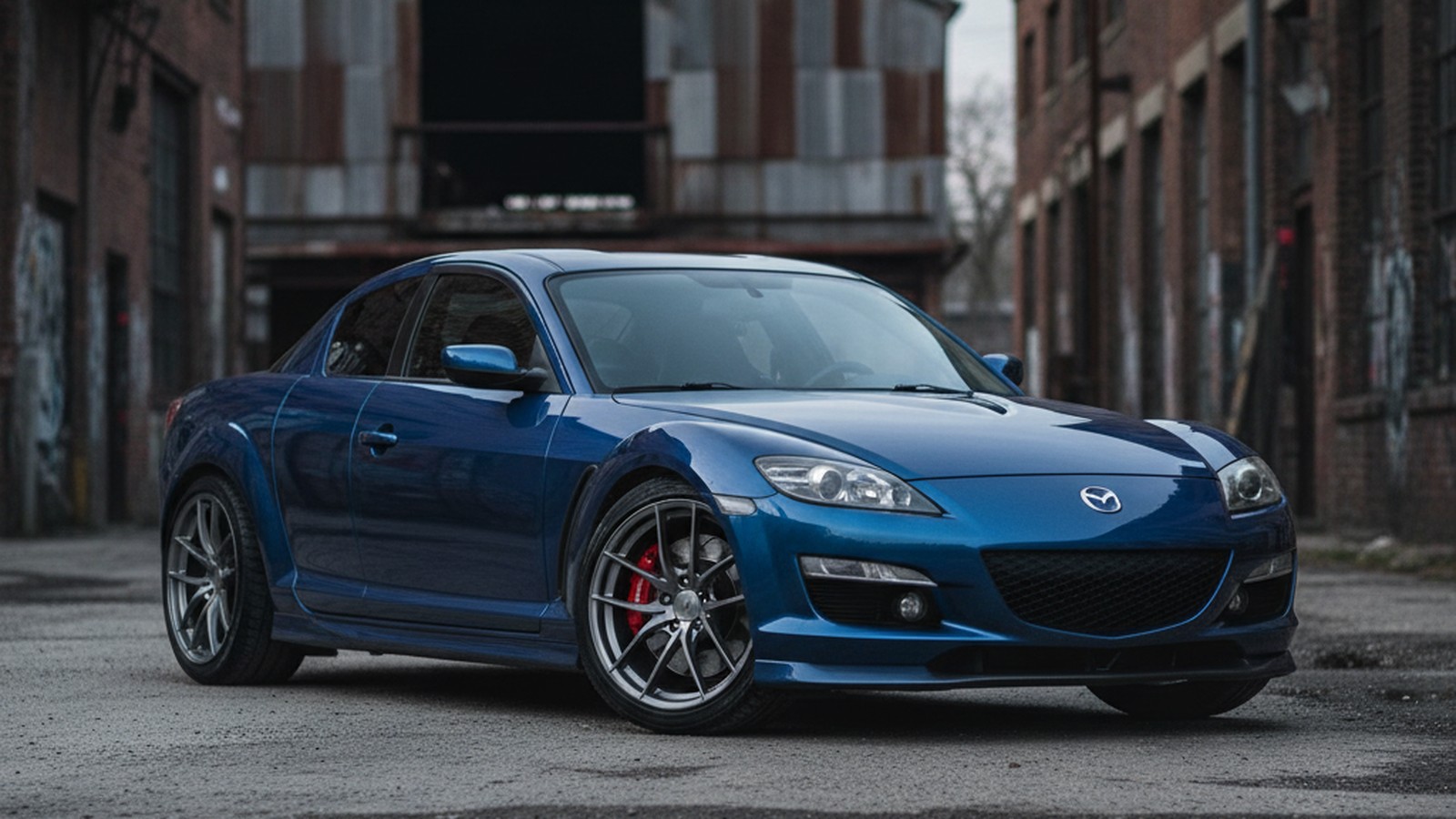
For many RX-8s, 18×9 with a good tyre and a measured offset is the real sweet spot. It fills the arches better than factory, sharpens the stance, and leaves enough practicality for road use. It also stays close enough to the platform’s original character that the car still feels like an RX-8 rather than a styling exercise.
19×8.5 to 19×9: Visual Impact with More Trade-Off
The RX-8 can run 19-inch wheels, and some cars do wear them well visually, but this is the point where compromise increases quickly. The chassis is sensitive enough that wheel weight and sidewall reduction become hard to ignore. A light 19 with a carefully chosen tyre can work on a road car, but a heavy 19 often makes the steering feel less delicate and the ride less composed.
Typical 19-inch street specs land around 19×8.5 or 19×9 with offsets in roughly the +40 to +45 range, often paired with tyres such as 225/35R19 or 235/35R19. The fitment can look sharp, but the RX-8 rarely needs 19s to look complete. For many owners, 19-inch wheels are more about style than pure chassis harmony.
That does not make them wrong. It simply means the owner should understand the trade. If the goal is visual presence first, 19s can make sense. If the goal is the best blend of response, comfort, and balance, 17s and 18s usually remain the stronger answer.
Square vs Staggered Setups
The RX-8 creates an interesting fitment conversation because some factory versions use slightly different wheel widths front and rear. That leads many owners to assume the car should always remain staggered. In practice, that is not necessarily true.
For aftermarket use, a square setup is often the smartest configuration. That means the same wheel width and tyre size on all four corners, or at least a very closely matched arrangement. A square setup simplifies rotation, makes tyre management easier, and usually produces more predictable handling balance. On a platform celebrated for its neutrality and steering, those are meaningful gains.
Common square ranges include 17×9 all round or 18×9 all round, often with 245-section tyres. This kind of fitment suits the car’s character well because it keeps the chassis honest and avoids the extra complexity of managing front and rear differences that may not offer a real-world benefit.
A mild staggered setup can still work if the goal is to preserve an OEM-inspired look or if a particular build calls for it. The key is restraint. The RX-8 is not a high-torque rear-drive coupe that needs a huge rear tyre to put power down. An exaggerated stagger often adds cost and reduces flexibility without meaningfully improving how the car drives.
If you want the wider reasoning behind this, Kaizen’s guide to staggered wheel setups is a useful companion. On the RX-8, the platform generally rewards a square or near-square philosophy more than a dramatic rear-heavy arrangement.
Brake Clearance, Hub Details, and Hardware
One of the easiest mistakes on the RX-8 is assuming that if the wheel is the right diameter, width, and bolt pattern, it must fit. Real fitment is more demanding than that. Brake clearance, inner barrel shape, spoke design, centre bore, and hardware all need to be correct.
Brake clearance matters because not all RX-8s use identical brake packages, and not all aftermarket wheels of the same listed size have the same spoke shape. A wheel can be an 18×9 with the correct offset and still foul the caliper because the spokes sit too flat or the barrel profile is too tight. This is why confirmed fitment data, templates, or physical test fits are so valuable.
The centre bore is straightforward but still important. The RX-8 uses a 67.1 mm centre bore. If the aftermarket wheel has a larger bore, the correct hub-centric ring should be used so the wheel locates properly on the hub. Skipping this step can create vibration that owners often misdiagnose as balancing trouble.
Hardware also deserves attention. The RX-8 commonly uses M12x1.5 hardware, but the seat type must match the wheel. If the wheel requires conical-seat nuts or bolts, use the correct ones. If spacers are fitted, hardware length must be adjusted properly. Small spacers can be useful for fine-tuning clearance, but they should not be used to rescue a wheel spec that was fundamentally wrong from the start.
For a more detailed explanation of hub-centric fitment, spacers, and wheel hardware, Kaizen’s wheel hardware and fitment essentials guide is worth bookmarking.
Suspension and Lowering Considerations
Suspension changes are where many otherwise sensible RX-8 wheel plans go wrong. A wheel and tyre package might be fine at factory ride height, then start rubbing once the car is lowered or once the alignment changes. The lower the car sits, the less margin for error you have.
Lowering springs are common on the RX-8 and can work well with 18×8.5 or 18×9 fitments if the offsets stay measured. A modest drop usually improves the visual stance without introducing major headaches. The trouble tends to begin when the car is dropped aggressively while also chasing wide wheels, low offsets, or tyres with very square shoulders.
Coilovers give more control, which is useful on this platform, but they do not remove the need for planning. They simply make proper planning more worthwhile. Height-adjustable suspension lets you dial in the relationship between the tyre and the arch more precisely, but spring rate, bump travel, and alignment still decide whether the car feels composed or compromised.
The front end is usually the tighter area. You have to think about guard clearance, liner clearance at steering lock, inner suspension clearance, and how much the tyre moves during compression. The rear can often accept a little more visual aggression, but that does not mean it is unlimited. A lowered RX-8 with passengers or real road load still compresses through its travel, and that is when poor fitment shows up.
Alignment is the other major piece of the puzzle. A small increase in negative camber can be useful for clearance and front-end support, but excessive camber used purely to force a wheel under the arch is usually a sign that the wheel spec itself is too aggressive. Toe settings matter just as much. Even a good fitment can feel unpleasant if the alignment is careless after suspension work.
The simplest rule is that ride height, wheel width, offset, and tyre size should always be chosen together. When owners pick them one by one, the result is usually a stack of compromises rather than a coherent setup.
Stance Options
OEM+ Street Fitment
This is the best approach for most RX-8s. The wheel sits fuller and cleaner than factory, the tyre still has enough sidewall to work properly, and the package respects the car’s light, agile character. Think 17×8.5 to 18×9, sensible offsets, and tyres that support performance without pushing the body or suspension too hard.
- Pros: clean stance, low drama, good drivability, easy to align, predictable clearance
- Cons: less dramatic visually than extreme fitments
Performance Flush
This is where many of the best enthusiast RX-8 builds end up. The wheels fill the arches properly, offsets are assertive without being reckless, and the tyre sits square on the wheel. On the right suspension setup, an 18×9 or 18×9.5 fitment can land here very well.
- Pros: stronger stance, improved tyre support, purposeful appearance
- Cons: less room for error, tyre choice becomes more important, lowered cars need careful planning
Aggressive Static or Show-Oriented
This is the area of very low ride heights, tighter tyre-to-guard relationships, and fitments chosen primarily for visual impact. The RX-8 can wear this style, but it is not the platform’s natural home. Once extreme camber, excessive stretch, or large spacers become necessary, the build is usually moving away from what makes the chassis enjoyable.
- Pros: strong visual impact, more custom appearance
- Cons: harsher usability, more rubbing risk, more alignment compromise, less faithful to the platform’s dynamic strengths
Wheel Construction and Weight
The RX-8 is one of those cars where wheel construction matters because wheel weight matters. This is not a heavy grand tourer that can shrug off an overweight wheel. The car’s steering and suspension are sensitive enough that you can feel the difference between a well-made lightweight wheel and a heavy one of the same nominal size.
Cast Wheels
A good cast wheel can work perfectly well on an RX-8 street car, especially in 17-inch or sensible 18-inch sizes. The key is avoiding unnecessary mass. If the wheel is significantly heavier than the factory package, the car can lose some of its crispness and become busier over broken surfaces.
Flow Formed Wheels
Flow formed construction is often the most logical choice for this platform. It tends to offer a better balance of strength and weight than many basic cast options, and that suits the RX-8 extremely well. For owners who want a sharper, more refined feel without going all the way to a fully forged wheel, this construction type is usually the sweet spot.
Forged Wheels
Forged wheels make sense when low weight and high strength are priorities, particularly for fast-road or track use. On the RX-8, a genuinely lightweight forged wheel can improve the sense of response and help the suspension stay calmer over repeated direction changes. They are not mandatory, but they do complement the chassis very well when the budget allows.
If you want a broader explanation of why these construction types feel different in practice, Kaizen’s cast vs forged wheels guide covers the trade-offs clearly.
Tyre Pairing Guide
Tyres are at least half of the fitment decision on an RX-8. The same wheel can feel completely different depending on whether it is paired with a soft-walled touring tyre, a sharp ultra-high-performance road tyre, or a track-biased compound with a very square shoulder. Because the car is so communicative, tyre construction has a real influence on steering feel, ride quality, and clearance.
Balanced Road Setups
For a street-driven RX-8, one of the cleanest pairings is 235/40R18 on an 18×8.5 wheel. It keeps the package tidy, gives enough sidewall for real roads, and tends to preserve the responsive feel that suits the chassis. On 17-inch wheels, 235/45R17 plays a similar role.
Enthusiast Road and Fast-Road Setups
If the car is driven harder, 245/40R18 on 18×9 is one of the best-balanced enthusiast combinations. It gives a little more support and footprint without pushing the car too far into compromise territory. On 17×9, many owners like 245/40R17 for the same reason.
More Aggressive Setups
For 18×9.5 builds, 245/40R18 or 255/35R18 can both make sense depending on the intended use. The 245 is often easier to manage for clearance and may feel a touch cleaner on the road. The 255 can offer more outright support and grip, but tyre model differences become very important here because some 255s run noticeably wider than others.
19-inch Tyre Pairing
On 19-inch setups, sizes such as 225/35R19 or 235/35R19 are common, but this is where ride quality starts to give way. The car can still look good, but the overall package has less sidewall to work with, and pothole resilience is reduced. That is another reason many RX-8 enthusiasts stay with 17s or 18s.
No matter which size you choose, remember that tyre labels do not tell the whole story. Different brands measure differently, and shoulder profile affects both clearance and steering response. A tyre that looks manageable on paper may run wider or squarer in reality. That is why measured fitment is always better than assumptions.
If you are still weighing up the whole package, Kaizen’s aftermarket wheel buying guide is a useful general reference.
Common Fitment Mistakes
- Choosing wheels by diameter alone: A 19-inch wheel is not automatically better, and a larger diameter does not guarantee brake clearance or better handling.
- Ignoring wheel weight: The RX-8 is sensitive to unsprung mass. Heavy wheels dull the steering and make the ride feel less composed.
- Assuming every 5×114.3 wheel will fit: Centre bore, spoke design, brake clearance, and offset all still matter.
- Using excessive spacers to force the look: Small adjustments can be fine, but large spacers often point to a poor base wheel choice.
- Going too aggressive after lowering: A setup that seems fine at static height can rub badly under load or steering movement.
- Relying on extreme camber to make wheels fit: Camber should refine a fitment, not rescue one that already sits too far outward.
- Copying another RX-8 without matching the conditions: Ride height, tyre brand, alignment, and brake package can all change the outcome.
- Overstaggering the car: Large front-to-rear differences usually add complexity without improving the balance the RX-8 is known for.
The pattern behind all of these mistakes is the same. Owners focus on one number or one visual goal and forget that fitment is a system. The best RX-8 setups work because the wheel, tyre, suspension, and alignment have been chosen as a package.
Legal and Road Compliance
Wheel and tyre rules vary depending on where the car is registered and inspected, so local regulations always take priority. In general terms, the safest approach is to keep the rolling diameter close to factory, maintain adequate clearance through steering lock and full suspension compression, use tyres with appropriate load and speed ratings, and make sure the wheel and tyre package remains properly covered by the bodywork.
Be especially careful with aggressive offsets, excessive changes in track width, and ride heights that remove too much suspension travel. A wheel that bolts on cleanly in the workshop is not automatically suitable for road use. It still needs to clear in real conditions: braking, cornering, bumps, passengers, luggage, and full steering input.
The good news is that the RX-8 usually points you in the right direction. The packages that look clean and drive well are often the same packages that stay sensible from a compliance and safety perspective. On this platform, balanced engineering and good taste tend to overlap.
FAQ
What bolt pattern does the Mazda RX-8 use?
The Mazda RX-8 uses a 5×114.3 PCD.
What is the centre bore of the Mazda RX-8?
The RX-8 uses a 67.1 mm centre bore.
What is the best all-round wheel size for an RX-8?
For most owners, 18×8.5 or 18×9 is the best all-round size because it suits the car visually and dynamically without adding unnecessary compromise.
Do 17-inch wheels work well on the RX-8?
Yes. A lightweight 17×8.5 or 17×9 setup can work extremely well, especially for owners who value steering feel, ride quality, and track-day usability.
Can I run 19-inch wheels on a Mazda RX-8?
Yes, but 19-inch wheels usually bring more trade-offs in weight, ride quality, and pothole resistance. They are generally chosen more for appearance than overall balance.
What offset is good for an 18×9 RX-8 wheel setup?
Offsets around +38 to +45 are a common starting range for 18×9 RX-8 fitments, though the exact answer depends on tyre size, ride height, and alignment.
Is a square setup better than a staggered setup on the RX-8?
For many aftermarket builds, yes. A square setup often improves tyre rotation options, keeps the handling more consistent, and suits the RX-8’s balanced chassis very well.
Do I need hub-centric rings on aftermarket wheels for an RX-8?
If the wheel has a larger centre bore than 67.1 mm, yes. The correct hub-centric rings help the wheel locate properly on the hub and reduce the risk of vibration.
Will lowering my RX-8 make wheel fitment harder?
Yes. Lowering reduces clearance during compression and steering movement, so offset, tyre size, and alignment become more critical.
What tyre size works well with 18×9 wheels on an RX-8?
245/40R18 is one of the most common and balanced pairings for an 18×9 RX-8 setup, provided the car’s ride height and alignment support it.
References
- Mazda RX-8 factory wheel and tyre specifications across trim levels and production updates.
- Manufacturer fitment data for 5×114.3 platforms using 67.1 mm centre bore and M12x1.5 hardware.
- Tyre manufacturer published dimensions for 235/45R17, 245/40R17, 235/40R18, 245/40R18, 255/35R18, and 235/35R19 sizing.
- Kaizen Wheels technical guides on offset, centre bore, wheel hardware, staggered setups, wheel construction, and aftermarket wheel buying fundamentals.
PHP: 2026-04-20 00:47:21 [notice X 0][/home/mensring/kaizenwheels.com.au/wp-content/plugins/elementor-pro/modules/forms/submissions/actions/save-to-database.php::193] {closure:ElementorProModulesFormsSubmissionsActionsSave_To_Database::__construct():193}(): Implicitly marking parameter $exception as nullable is deprecated, the explicit nullable type must be used instead [array (
‘trace’ => ‘
#0: ElementorCoreLoggerManager -> shutdown()
‘,
)]
PHP: 2026-04-20 00:47:25 [notice X 0][/home/mensring/kaizenwheels.com.au/wp-content/plugins/elementor-pro/modules/forms/submissions/actions/save-to-database.php::193] {closure:ElementorProModulesFormsSubmissionsActionsSave_To_Database::__construct():193}(): Implicitly marking parameter $exception as nullable is deprecated, the explicit nullable type must be used instead [array (
‘trace’ => ‘
#0: ElementorCoreLoggerManager -> shutdown()
‘,
)]


